
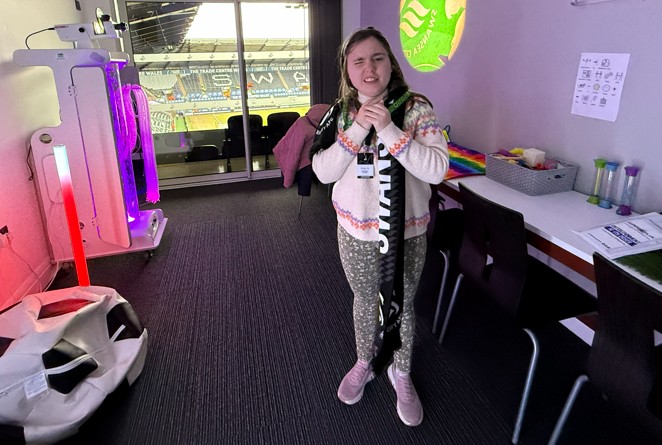
If you’d told me a few years ago that I’d be taking Kya to a live football match – twenty thousand people, a wall of noise, floodlights, chanting, the whole lot – I’d have said you were out of your mind. A football stadium is basically everything Kya finds difficult, concentrated into one place and turned up to eleven. Crowds. Unpredictable noise. Strangers everywhere. Nowhere quiet to go. It should have been impossible.
It isn’t. It’s one of our favourite things.
It started with Swansea City. I’d heard that the Swansea.com Stadium had a sensory room – a proper one, not a cupboard with a lamp in it – and that the Disability Supporters Association at the club were brilliant with families like ours. So I got in touch, half expecting the usual runaround of forms and waiting lists and “we’ll get back to you.” Instead, they got back to me the same day. Friendly. Helpful. Genuinely interested in making it work.
The first time we went, I was nervous. Not about the football – about Kya. I had the headphones ready. The Kindle charged. Snacks packed. An escape plan in my head for every scenario. Sarah and I had talked through the whole thing the night before like we were planning a military operation. What if she hates it? What if the noise is too much? What if we have to leave at half-time? We were ready for all of it.
We didn’t need any of it.
From the moment we arrived at the stadium, we were looked after. A friendly face at the entrance – not a security guard doing a job, an actual person who knew we were coming and was waiting for us. They walked us through the concourse, away from the busiest bits, and took us straight to the sensory room. No queues. No fuss. No having to explain who Kya is or what she needs. They already knew.
The sensory room itself is beautiful. It’s not clinical. It’s not an afterthought. It’s a proper, thoughtfully designed space with soft lighting, beanbags, sensory equipment, fidget toys, and – this is the clever bit – a set of patio doors that open directly into the stadium. You can slide them open and watch the game with the crowd, feel the atmosphere, hear the singing. Or, if it gets too much, you close the doors and watch through the glass. The noise drops. The world gets quieter. But you’re still there. Still part of it. Still at the match.
Kya found the beanbags within about four seconds. She planted herself on the biggest one, headphones on, Kindle in her lap as a backup, and looked out at the pitch like she’d been coming here for years. When the teams came out and the crowd roared, she didn’t flinch. She flapped. The happy kind. The kind that means this is brilliant.
The doors were open. Twenty thousand people singing. And Kya was on a beanbag, flapping with joy, right in the middle of all of it. On her terms. At her volume. Completely happy.
The DSA team and the stewards checked on us throughout the entire game. Not in an intrusive way – just a head round the door, a smile, a “everything alright in here?” They brought us drinks. They asked if Kya needed anything. They treated her like she belonged there, because she did. That’s the thing that gets me every time. They don’t just tolerate disabled fans. They welcome them. Properly. With warmth and thought and care.
When Swansea scored, the room shook. The roar from outside hit the glass like a wave. And Kya – my little girl who can’t handle a hand dryer – looked up from her Kindle, grinned, and started bouncing on the beanbag. She loves the cheering. She loves the singing. Not despite how loud it is, but because of it. Because it’s predictable in a way that everyday noise isn’t. A crowd singing together is one sound, one rhythm, one thing her brain can follow. It’s not forty radio stations at once. It’s one enormous voice, and she wants to be in the middle of it.
We’ve been back many times since. It’s become our thing – Saturday 3pm, me and Kya, beanbags and football. She knows the routine now. Car. Stadium. Friendly face. Sensory room. Beanbag. Doors open. Kindle ready just in case, but usually forgotten within ten minutes because the match is more interesting. She doesn’t follow the game in the way I do – she’s not tracking the score or watching the tactics. She’s feeling it. The energy, the noise, the rise and fall of the crowd. The atmosphere is the experience. The football is almost secondary.
And it’s not just Swansea. Over the past couple of years we’ve taken Kya to grounds all over the place. Exeter were welcoming. Newport were great. And Cheltenham – Cheltenham deserve a special mention, because the DSA team there went above and beyond. From the moment we contacted them they were incredible. Helpful, thoughtful, genuinely interested in getting it right for Kya. They didn’t just accommodate us – they made us feel wanted. That matters more than people realise.
Every ground is different. Some have dedicated sensory rooms. Some have quiet areas. Some just have really good people who understand that not every fan experiences match day the same way. The common thread, every single time, has been the people. The stewards who give Kya a wave. The DSA volunteers who remember her name. The fans nearby who don’t bat an eye when she flaps or bounces or puts her headphones on. Football, for all its noise and chaos, has been one of the most inclusive things we’ve ever done.
If you’re reading this and thinking it sounds impossible for your child – I get it. I thought the same. But it’s worth looking into. A brilliant organisation called Level Playing Field helps disabled fans access live sport across the country. They can point you in the right direction, tell you which grounds have what facilities, and help you make that first contact. They’re doing incredible work, and they’re worth knowing about.
I’ll write more about them – and about how to actually set up that first visit – in a follow-up post. Because there are things I wish I’d known before our first match, and if I can make it easier for the next family, I will.
But for now, this is the bit I want you to take away: my daughter, who can’t handle a busy supermarket, sits in a football stadium with twenty thousand people singing around her and she is happy. Not coping. Not surviving. Happy. Beanbag happy. Flapping happy. Bouncing-when-they-score happy.
Saturday 3pm. It’s our thing now. And I wouldn’t swap it for anything.
Share this story