
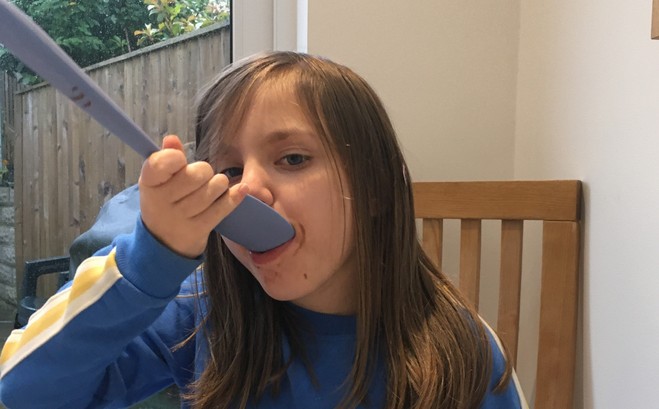
If you looked at Kya’s plate when she was little, you’d see one colour. Beige. Everything beige. Cheese sandwich – beige. Chicken nuggets – beige. Croquettes – beige. Waffles – beige. Pasta, no sauce – beige. Pizza, but only the plain kind – beige. Baked beans were the wild card, and even those are basically orange beige.
That was the menu. The whole menu. Five or six things, rotated on repeat, and if you tried to introduce anything new she’d look at it like you’d put a spider on her plate. It wasn’t fussiness. It wasn’t stubbornness. It was sensory. Everything about food is sensory – the texture, the temperature, the colour, the smell, the way it feels in your mouth, the sound it makes when you chew. For Kya, who already processes the world at ten times the volume, food was just another thing that had to pass through a very specific filter before it was allowed in.
Beige food passed the filter. Beige food was predictable. It was dry, or crunchy, or familiar. It didn’t surprise her. It didn’t have an unexpected texture hiding inside a normal-looking outside. A chicken nugget is a chicken nugget every single time. A cheese sandwich is safe. Beige food made sense.
But we kept trying. Not pushing – never pushing. Just quietly, every meal, adding something small to the side of her plate. A few peas. A couple of carrot sticks. A tiny pile of sweetcorn. Not replacing anything, not making a fuss, just putting it there like it had always been there, and seeing what happened.
For months, nothing happened. The peas sat untouched. The carrots were moved to the far edge of the plate like they were contaminating the nuggets. The sweetcorn was ignored entirely. We didn’t comment. We didn’t say “try a pea, Kya” or “just one bite.” We just left them there, meal after meal, day after day, and let her decide.
Then one evening, right at the end of her tea, when the nuggets were gone and the plate was nearly empty, Kya picked up a pea. She looked at it. Rolled it between her fingers. Studied it like a scientist examining a specimen. And then she popped it in her mouth.
We held our breath. And then… nothing. She didn’t swallow it. She didn’t spit it out. She just kept it in her mouth and carried on with her evening. Went to the sofa. Watched her programme. Went for a bath. Went to bed. The pea, presumably, went with her.
That night I found it under my pillow.
Over the next few weeks, peas started turning up everywhere. Under cushions. In the bath. Behind the sofa. On the windowsill. Tucked into the arm of the chair. Kya was popping them in her mouth at mealtimes – which felt like progress – but she wasn’t swallowing them. She was carrying them around like little green souvenirs and depositing them in random locations around the house. It was like living with a very small, very quiet squirrel.
Soft food was the problem. Peas were too squishy, too strange, too unpredictable in the mouth. Beige food crunches. Peas don’t. That was the gap she couldn’t cross – until she found her own way across.
Then one Sunday, I watched her do something extraordinary. She popped a pea in her mouth – the usual routine – and then immediately grabbed her cup of squash and took a quick swig. Like she was swallowing a tablet. Pea in, squash down, gone. She didn’t even pause. Just moved straight on to the next one. Pop. Swig. Pop. Swig.
I nudged Sarah. We both watched, trying not to stare, trying not to make it a thing. Kya was eating peas. Actually eating them. In her own way, on her own terms, with her own system – but eating them. The squash was the bridge. It washed away the texture she couldn’t handle and got the pea where it needed to go. She’d solved the problem herself. Brilliant.
A few months of pea-and-squash later, I noticed her looking at the carrots. Not eating them – just looking. Studying them the way she’d studied the peas before. Then one Sunday she picked up a piece of carrot, dunked it in gravy until it was completely soaked, and ate it. No squash needed. The gravy did the job – softened the edges, made it familiar, gave it a flavour she already trusted.
Sarah and I looked at each other across the table. Kya was eating a full Sunday dinner. Chicken. Roast potatoes. Peas – via squash. Carrots – via gravy. And lots more gravy on top of everything, because gravy is apparently the universal translator of food. I could have cried. I think Sarah actually did.
As she got older, the world opened up a bit more. We started taking her to cafes and restaurants – carefully, slowly, always with headphones – and her menu started to grow. Spaghetti bolognese became a favourite. Then baked potatoes with cheese, obviously. Then jacket potato with beans. Each new food was a tiny revolution, won through patience and time and absolutely zero pressure.
She’s still selective. She always will be. There are foods she won’t touch and textures she can’t handle and days when she goes back to the beige basics because that’s what feels safe. And that’s fine. The point was never to make her eat everything. The point was to let her discover, at her own pace, that there’s more out there than nuggets.
If I had one piece of advice for any parent going through the beige phase – and I know how exhausting it is, I know the worry, I know the guilt when someone side-eyes what’s in your child’s lunchbox – it would be this: keep putting something new on the plate. Don’t mention it. Don’t make it a battle. Don’t force it. Just let it sit there, quietly, meal after meal, and let them come to it in their own time. One day they might ignore it. One day they might pick it up and put it back. One day they might pop it in their mouth and carry it around for three hours before leaving it under your pillow.
And one day – maybe not today, maybe not for months – they might eat it. With a swig of squash and a face that says “what’s the big deal?” while you and your partner try not to burst into tears at the dinner table.
The plate doesn’t have to be a rainbow. It just has to be a little less beige than it was yesterday.
Share this story